
Calorie guide
Understanding Calories: Visual Portion Guides & Deficits
A calorie is a measure of the energy in food. The NHS guideline is around 2,000kcal a day for women and 2,500kcal for men to maintain weight, although individual needs vary. To lose about 1lb (0.5kg) a week, most people need to eat roughly 500–600kcal a day less than they use.
Last reviewed:
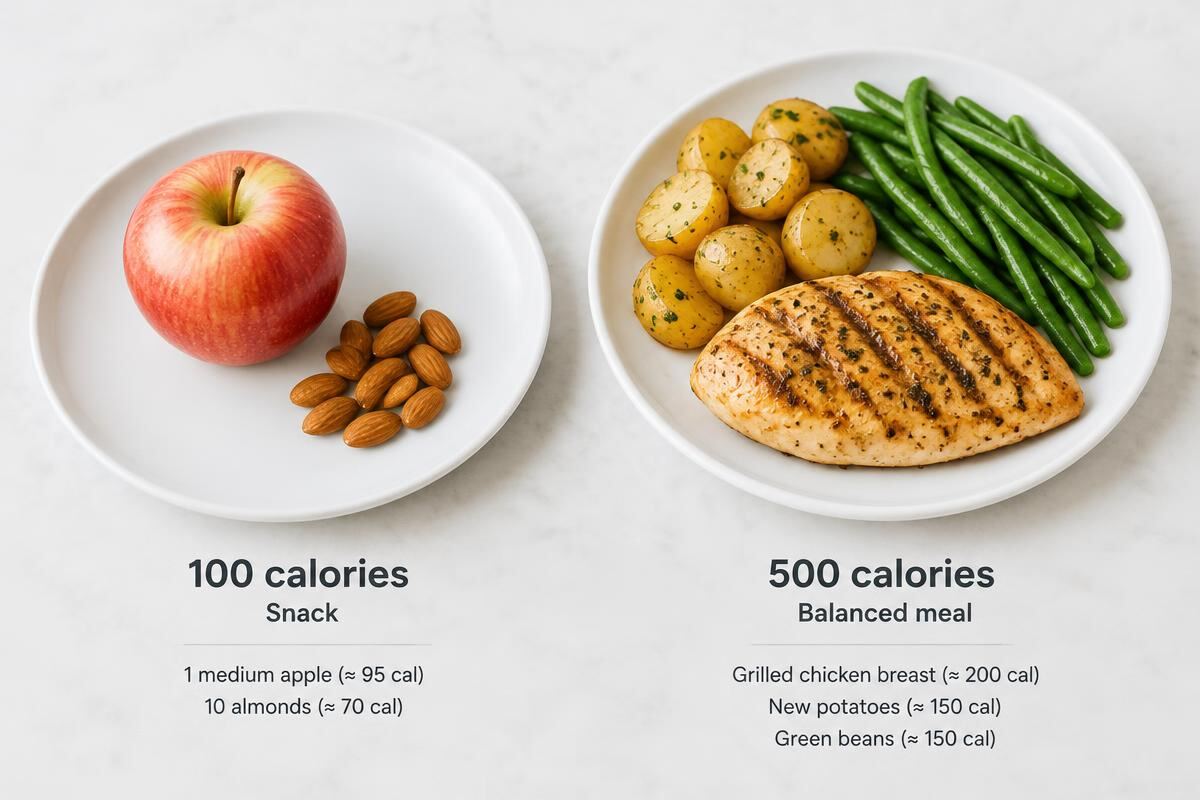
What does 100 calories look like?
Approximate amounts — check labels, as products vary.
| Food | Roughly 100kcal is… |
|---|---|
| Apples | 1½ medium apples |
| Strawberries | About 300g (a large bowl) |
| Cheddar cheese | A 25g piece — the size of two dice |
| Butter | About 14g — roughly three level teaspoons |
| Olive oil | About 11g — just under one 15ml tablespoon |
| Bread | 1 medium slice of wholemeal |
| Peanut butter | 1 level tablespoon (16g) |
| Crisps | Most of a standard 25g bag |
| Broccoli | About 300g — a very large plateful |
| Milk chocolate | 4 small squares (19g) |
What does 1,000 calories look like?
It's surprisingly easy to reach 1,000kcal in a single sitting — or surprisingly hard, depending on what you choose:
- A large takeaway pepperoni pizza can be 2,000kcal or more; half of it is about 1,000kcal.
- A cooked breakfast with sausages, bacon, fried egg, fried bread, beans and black pudding easily passes 1,000kcal.
- By contrast, the same 1,000kcal spent on lighter foods such as porridge with fruit, a chicken salad wrap or a jacket potato with beans covers several filling meals.
How much do you need?
Your energy needs depend on your basal metabolic rate (BMR — the energy used at rest) plus everything you do. Bigger and more active people need more. As you lose weight, your needs drop slightly, which is one reason progress slows over time.
Use our activity calorie calculator to estimate what different activities use.
Creating a sensible deficit
- Moderate: 500–600kcal a day below maintenance — around 0.5kg (1lb) a week.
- Larger: up to 1,000kcal a day — around 1kg (2lb) a week, usually only appropriate for people with more weight to lose.
- NICE advises that low-calorie diets of 800–1,200kcal a day should only be followed as part of a supported weight-management programme, and diets below 800kcal need specialist support. Speak to your GP before cutting calories this far.
Combining eating changes with more movement is easier than relying on either alone.
Calorie squanderers
Calories you barely notice are the ones to cut first: a latte with whole milk (around 200kcal), a handful of nuts eaten straight from the bag, the second glass of wine, sugar in tea. Trimming three of these a day can create most of a deficit without changing your meals.
Keep reading
A new free meal plan every Monday
Balanced UK menus with a matching shopping list, published here on the site. Look back at previous weeks any time.
See this week's plan